Paint protection film is worth it on some Ottawa cars and a poor buy on others, and the difference is not the badge on the hood. It comes down to what you drive on, how long you plan to keep the car, and what the paint is worth to you. This guide works through the real downsides, what the film stops on the 417 and the 174, and the cases where we tell people to keep their money.
Is paint protection film really worth it?
Sometimes. That is the honest answer. On some ordinary cars film is a waste of money, and on a car that runs the 417 every weekday it is not.
Whether it pays for itself comes down to three things. The first is what you drive on. A commuter that spends its mornings behind aggregate trucks between Kanata and downtown collects chips at a rate a car that stays inside the Greenbelt never sees. The second is how long you keep the car. Film is a cost you pay once and recover over years, so a car that leaves in twelve months rarely earns it back. The third is what the paint is worth to you, which is a question of taste as much as money: some owners can live with a peppered hood and some cannot look at it.
What does PPF actually stop in Ottawa?
Stones, mostly. The 417 between Moodie Drive and Eagleson Road has been under construction on and off for years, and its lanes carry a steady run of transport and gravel trucks that throw aggregate at whatever is following them. The 174 through Orléans does the same where construction has scattered loose stone across the lanes. The front bumper takes the small hits, the leading edge of the hood takes the ones that break through the clear coat, and a mirror cap can lose a chip a month without anyone noticing until the spring wash.
Then there is the brine season, November to April. Salt brine goes down on the highway ahead of a storm, sand goes down on top of it, and the two make a slurry that finds every existing chip and starts lifting the paint around it. Film gives the salt nothing to get behind. Out past Kanata, the gravel shoulders around Carp and the estate roads around Greely do their damage at 60 km/h instead of 100.
The arithmetic is short. A proper chip repair runs $200 to $800 per chip at a body shop, and a panel repaint starts around $1,500. A dozen chips is an ordinary winter on the 417. A partial front sits between those repairs and your paint for years, and the PPF page lists what each level of coverage includes.
What is the downside of PPF?
The price is the first one. Film costs more than a ceramic coating over the same panels and far more than doing nothing, and the money is spent whether or not a stone ever reaches the car.
The rest of the list depends on who installs it. Cheap film has orange peel, a texture you see in the reflection of a streetlight. A rushed install leaves edges that stop short of the panel gap and dirt sealed under the film. Film locks in whatever is beneath it, so a swirl or a chip that was there on install day is there for the life of the film. Old-generation film yellowed, and a bargain roll bought online still can. Removal over a repainted panel can lift the repaint with it.
A good install removes most of that. We wash and decontaminate the paint before any film goes on, tuck every edge into the panel gap so nothing stands proud, and check for repainted panels at the quote, while you can still say no. What no installer removes is the price, or the possibility that you are paying to protect paint you would have lived with anyway.
Does PPF yellow?
Modern film should not, and the difference is generation and top coat, not brand. The films that yellowed were older products with no UV-stable layer on top. Sun broke them down, and white cars showed it first. Current films are thermoplastic urethane with a clear top coat that carries the UV protection, and that same top coat is where the self-healing happens.
The films we install, 3M, Hexis BodyFence and STEK, carry manufacturer warranties of up to 10 years, and yellowing is one of the failures they name alongside cracking, peeling and staining. Two things can still discolour a modern film: a summer parked under a sap-dropping tree, and brine left to dry on the nose for months. Both are care problems, and following the care instructions that leave with every car is a condition of the film warranty.
How long does PPF last, and what happens after 10 years?
Premium film lasts 7 to 10 years with proper care, and the manufacturer warranty runs up to 10 years. Proper care is not complicated: a hand wash with a pH-neutral soap, no brush washes, pressure wands kept back from the edges, and sap or bird droppings off the same day they land.
Past ten years the film has done its work and is wearing out. The top coat thins and the self-healing slows with it. The edges start to catch a wash mitt. That is the point to remove it, with heat, and the paint under it is the paint from the day it went on. Whether to film the car again is the same question as the first time, asked about a car that is now ten years older, and the honest answer is often no.
Is PPF worth it on a new car, a used car, a white car, a black car, a truck?
A new car
Yes, if you keep your cars. Film goes on cleanest over paint that has never been chipped, because it locks in whatever it covers, and the first week of ownership is the window, before the first run down the 417.
A used car
It depends on the paint. A used car with a peppered hood needs the chips filled and often a repaint before film makes sense, and film over a repaint carries a removal risk. A three-year-old car with clean paint is a new car for these purposes.
A white car
White hides chips from ten feet away and shows yellowing sooner than any other colour. On current film that concern has passed. The chips have not: white paint chips exactly like black paint, you simply see less grey primer through it.
A black car
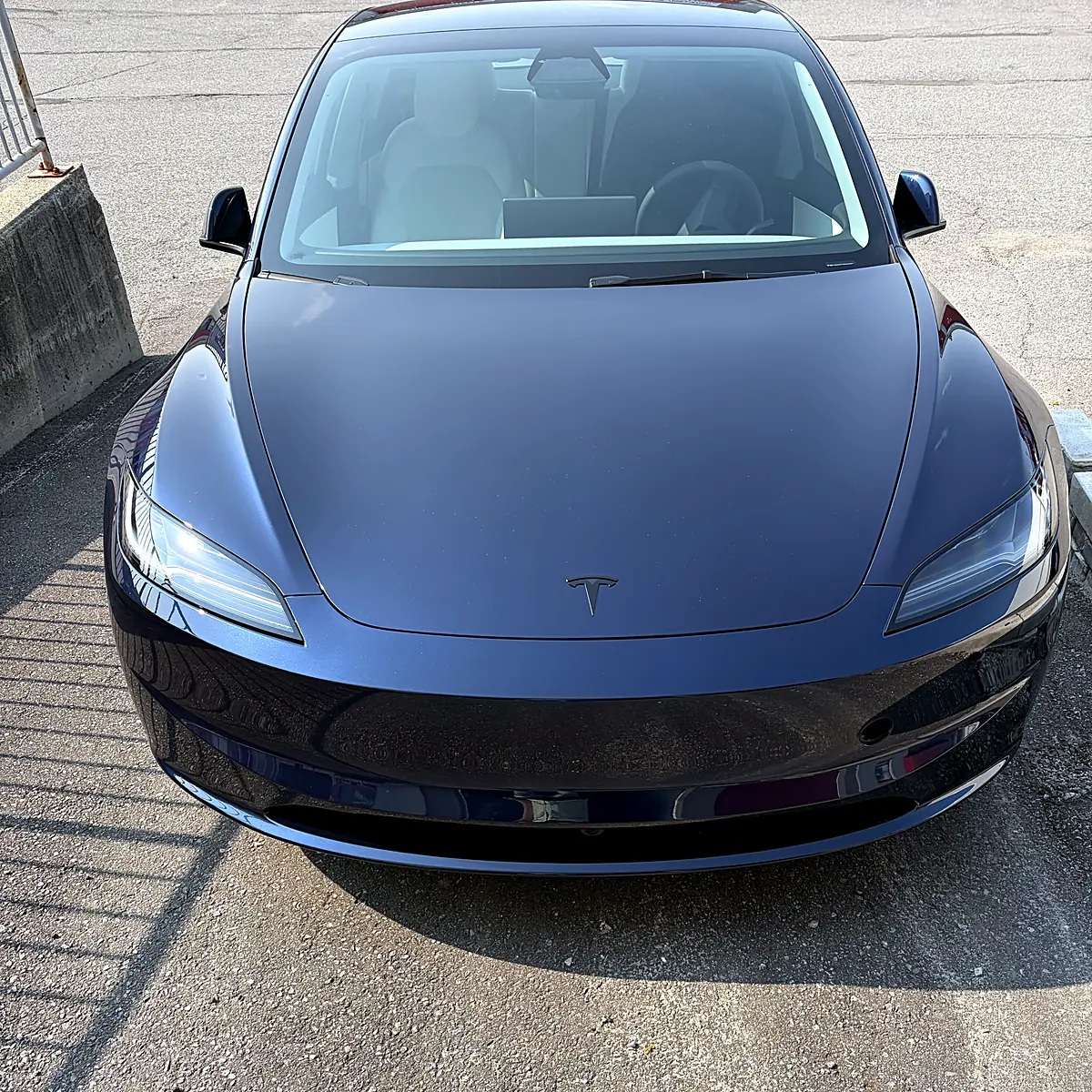
Black shows every chip and every mark a brush wash leaves. The self-healing top coat closes the swirls in the sun, and on a black car that is worth nearly as much as the chip protection. Tesla’s black and midnight silver finishes show swirls first, and the Orléans Tesla page covers the model-specific cuts.
A truck
A truck that tows to Calabogie or runs gravel to a job site earns a full front faster than any sedan. A truck that lives in a Barrhaven driveway and carries the recycling does not. Trucks also stand taller, so the rocker panels take the tire-thrown gravel that never reaches a low car’s doors.
Is PPF worth it on a leased car in Ontario?
More often than people expect. A lease in Ontario ends with a return inspection, and the wear guide that came with your agreement sets out what counts as excess wear. Stone chips are on that list once they pass a certain size or number, and three Ottawa winters can produce exactly that on an unprotected hood. The bill for it arrives after you have handed back the keys.
Film changes the arithmetic in two ways. The chips land in the film, and the film comes off cleanly from good paint when the lease ends, so the car goes back with the paint it left the lot with. A partial front is the sensible tier for a lease: it covers the zones the inspector looks at first, at a fraction of the price of a full body. One caution: ask the leasing company in writing whether clear film may stay on at return, because some accept it and some want it removed, and removal is work we do. The short form of this answer sits in the PPF page FAQ.
Which coverage is worth paying for?
For most Ottawa drivers, the front. The four packages run from a partial front through a full front to a full body, with a custom-cut tier for complex bodywork. The partial front covers the bumper, the hood’s leading edge, the fenders and the mirrors, the zones that take nearly every stone. A full front extends across the whole hood and the full fenders, with the A-pillars where the pattern allows, and it is the right tier for a daily 417 or 174 commute because at highway speed the stones reach the back of the hood.
Full body is for a car whose paint you intend to keep perfect. It is the right answer for a small number of owners, usually with a car that would cost a great deal to repaint. Kanata commuters are usually quoted a full front. Glebe residents who park on Bank Street on a game day have a different worry, their doors, and the Glebe page explains why. Run your own vehicle through the quote calculator for a starting figure, then call, because the figures are ranges and there is often a better one.
When we tell people not to buy PPF
We turn down film jobs, and these are the cases. If the clear coat is already failing, with that chalky, peeling look on a hood or a roof, film will not bond properly and it will take the failing paint with it when it comes off. Paint first and film later, or neither. If the car is leaving within a year, sold or returned, the film is a gift to the next owner. Keep the money. If the budget reaches a hood strip and no further, wait. A strip alone leaves the bumper and fenders bare and draws a visible line across the hood. Save for a partial front, or read how spreading the cost works and decide whether monthly payments beat another season without protection.
And if what you want is a car that stays clean and glossy rather than a car that stops stones, film is the wrong product. A ceramic coating does that job for less over the same panels, and our PPF vs ceramic coating guide sets the two side by side. If you want a new colour, read wrap vs PPF before you spend anything. When film is the wrong buy, we would rather say so at the quote than take the deposit.