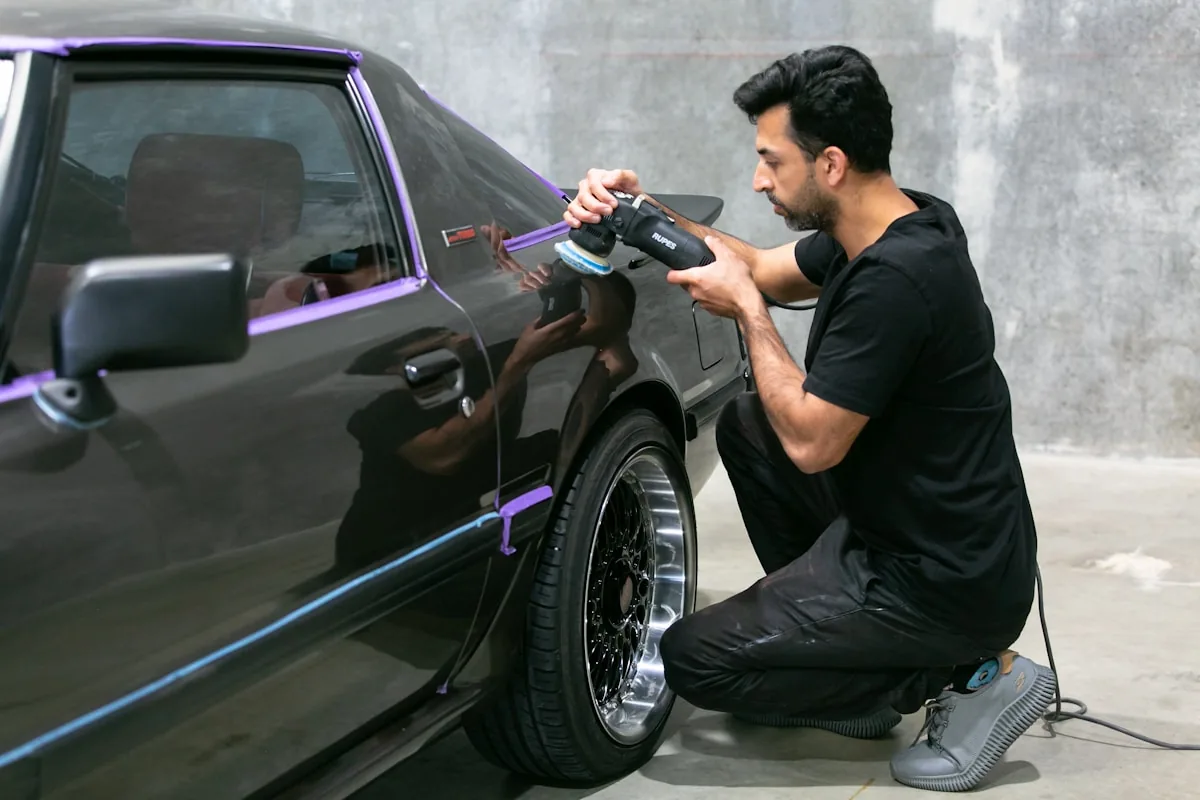
Most Ottawa cars earn back a ceramic coating in the salt months, one winter rinse at a time. A few never will, and it is the owner's habits rather than the car that decides which. This guide covers what a coating does to road brine, what it will never do to a stone, the downsides in plain words, the package the dealership offered at delivery, and the cars we would rather not coat.
Is ceramic coating really worth it?
For most cars in this city, yes. Run a gloved hand along the lower door of one that has spent the winter outside. It grates. That roughness is a winter of brine film and sand bonded onto the clear coat, and it is why people here ask about a ceramic coating.
A car its owner washes, and keeps for a few more winters, pays the coating back every week from November to April. Two kinds of car do not: the one that will keep going through the brush wash on Saturdays whatever we say at pickup, and the one that leaves in the spring.
The rest is expectation: anyone who buys a coating as armour is disappointed by the first stone.
What does a ceramic coating actually do?
It makes the paint slippery and hard to stain. It does not make the paint hard to hit.
Think of it as a hard, slick layer of silica polymer a few microns deep, bonded onto the clear coat rather than resting on it like a wax. Once cured, nothing wet wants to stay: brine, droppings and water spots sit on the surface until the hose finds them, provided that is within a day or two. The shine outlasts a wax by years, and the layer takes the UV that would otherwise be fading the paint.
Now the other half. A stone at highway speed goes straight through it. So does a key, or a shopping cart. The 9H on the bottle is a pencil test on a flat panel; it grades the coating against pencil leads, not stones. And it hides nothing: a swirled hood, coated, is a swirled hood under a sharper reflection. That is why preparation is most of the job; the ceramic coating page lists every step.
Why is the salt season the whole argument in Ottawa?
Follow a salt truck east on the 174 through Orléans on a January morning and watch what it lays down. It goes down wet, so it runs into every seam and hangs on the door faces, and by the time you are home it has dried to a film a quick wash leaves behind. Then the sand goes on top, and the car ahead of you throws it at your lower doors all the way in. The 417 from Kanata is the same drive.
On a coated door the same brine dries on the coating instead of in the clear coat, and a rinse lifts it whole. The sand skids rather than digs. A February Sunday goes from a bucket, a mitt and cold hands to five minutes with the wand at the self-serve. A coating does not make salt harmless; it makes salt easy to remove.
That is the argument, and not the gloss. For timing, the winter installation guide has the calendar for film, coating and tint.
What are the downsides of ceramic coating?
Under the bay lights a swirled hood looks no better coated than bare, and the swirls read sharper. A coating amplifies whatever is under it, so the correction that fixes the paint first is the largest single line in any honest quote, and the few microns of clear coat the polisher takes off do not come back.
For a week the car is a patient: out of the rain for the first day, out of any wash for seven. After that the habits stick for the life of the coating: two buckets and a pH-neutral soap, a touchless bay in the weeks a hose is misery, and never the brushes, which mar a coating as readily as bare paint and which the care sheet writes into the warranty. Wax on top is a waste rather than a downside; it buries the beading. It costs several times what a good wax costs, and a fraction of what film costs.
It does not stop a chip or a scratch. And it wears out: one, three or five years by package, then the car is decontaminated and coated again.
What does ceramic coating cost in Ottawa?
Across every package on every passenger vehicle, ceramic coating at Wrap Senators runs $500 to $2,100. The floor is a sedan on the 1-year package; the ceiling is a luxury car on the 5-year package.
Four things move a quote inside it. The package length. Whether correction is included: it is on the 3-year and 5-year packages, quoted separately on the 1-year. Vehicle size: a truck carries more paint than a sedan. And the condition of the paint, which decides how many hours the polisher runs.
That last one is why two quotes for the same package can sit far apart: one shop priced the hours on the polisher, the other priced the bottle. Every figure in the package table is a range we often come in under, so call before you budget from it.
Is the dealership’s ceramic coating worth it?
The dealership offered a ceramic package at delivery; is it any good? We cannot judge a coating we did not apply. What we can give you is the questions to have answered, in writing, before you sign.
Which product, by name. Who applies it, in what space, and how long the car stays indoors afterwards. Whether the paint was decontaminated, clayed, wiped and corrected first, because a coating over paint that skipped those steps locks every flaw in under a shine and lets go wherever polishing oil was left behind. What the warranty covers, and what it requires of you. And the price against a detailer’s package with the same term, correction included.
If nobody can name the product, you have your answer. If they can, get it on the invoice.
Is ceramic coating worth it on a new car, a used car, a black or white car, a truck?
A new car
The best case. Straight from the lot there is usually nothing to correct, and the coating goes onto paint that has never seen a salt season. Book it before the first brine goes down.
A used car
The paint decides. Swirls, light oxidation and water spotting come out with a single-stage pass. A deep scratch does not. A clear coat that is chalking or lifting is a no; a coating over it peels with it.
A black car
Black shows every swirl a wash mitt ever left, so it is where correction plus coating shows the most. Black paint three winters into Ottawa life, corrected and then coated, is the finish the photographs are made of.
A white car
Swirls disappear into white paint from a few steps back, so the gloss argument is weaker. The brine argument is identical.
A truck or work van
SUVs and trucks cost more than a sedan, and a work van carries two or three sedans’ worth of paint, so vans and fleets are priced one at a time. A tall truck’s rocker panels sit right where the winter sand lands, and those are the panels that make the case for a coating. A fleet van that meets a brush wash every Friday is the wrong candidate.
Which package is worth paying for?
The three packages carry the years the coating is warranted for. The 1-year package is a real coating on a shorter clock, not a compromise, with correction as a separate line when the paint needs it, and it is the fit for a lease in its last year. The 3-year package includes a single-stage correction and puts the next decision three winters away. The 5-year package includes the same correction and builds the coating up in layers, for the owner who wants the strongest beading and the longest run between renewals. If the budget covers the coating but not the correction the paint needs, wait; a coating over uncorrected paint sharpens the marks you were hoping to hide.
Wheels and glass are the add-on that earns its place in winter. Brake dust lands hot and welds itself to the wheel face within a few drives; coated, it comes off under a pressure wand, and the coating takes the caliper’s heat. At highway speed rain sheets off a coated windshield, ice lets go faster, and salt haze struggles to build. The glass coating wears sooner than the paint coating, because wipers are abrasive.
Would film or a wax do the same job for less?
A wax is the cheap answer and it is honest about it: a few weeks of Ottawa weather and it is gone. A synthetic sealant lasts a few months. Neither has any hardness. Film is the expensive answer to a different question: a physical layer against stones and scrapes, on the impact panels or the whole car, for up to ten years. The coating sits between them on price and does the chemistry job, brine, droppings, UV and water spotting, for one to five years by package. It does nothing about the stone.
Many Ottawa cars carry film on the front and a coating everywhere else. The PPF vs ceramic coating comparison sets out which one stops what, and is PPF worth it in Ottawa runs film through the same test.
When is a ceramic coating not worth it?
The owner uses brush washes and intends to keep using them: the coating would be marred inside a season. The car leaves in the spring: a coating bought in October for a car sold in April is bought for whoever drives it next. The clear coat is already failing, chalky on the roof or lifting at a hood edge: paint first, or nothing. And a buyer who wants the paint to survive stones wants film, and we will quote it.
If none of those is you, bring the car by. We are at 2415 Stevenage Dr, off Innes Road on the east side, fifteen minutes or so from Orléans; the Beacon Hill and Rockcliffe Park pages have the local detail. We look at the paint under the lights before we quote it, and if your car does not need a coating, you hear that too. Start with the quote calculator, or send us the details.