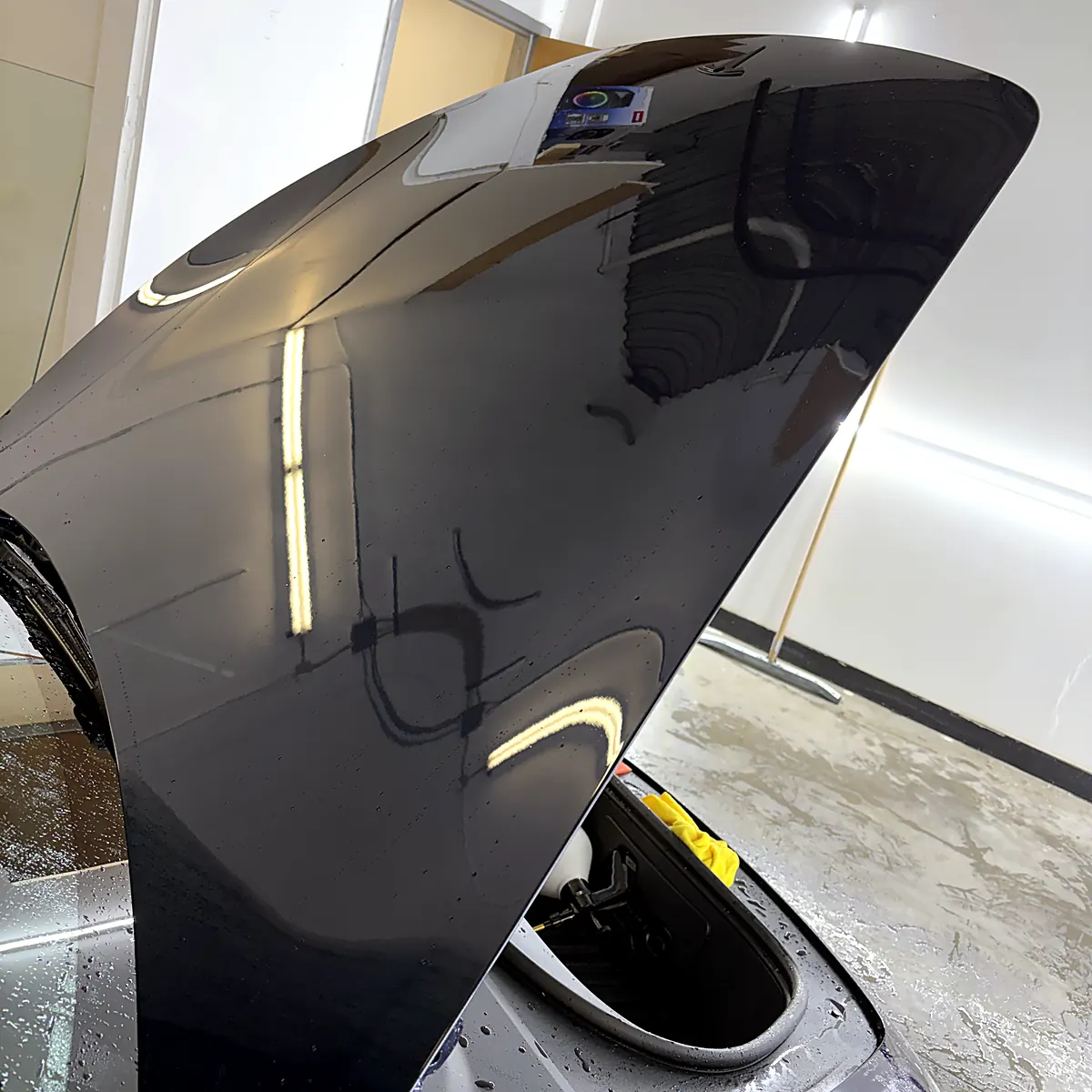
PPF, ceramic coating and window tint all go on in an Ottawa winter, because every installation at Wrap Senators happens indoors in a climate-controlled bay. What the cold changes is the cure, the drive home and the longer wash that comes before the work. It also decides when in the calendar the protection does the most good. This guide takes the three one at a time, adds a short word on wraps, and ends with when to book.
Can you install PPF, ceramic coating or window tint in an Ottawa winter?
Yes, all three, any week of the year. A car comes off Innes Road in a February squall with brine crusted to the door handles, gets washed in the bay, and goes back out with film on its nose or fresh tint on its glass. The install does not know what month it is. Every job we do happens indoors in a climate-controlled bay, because adhesive sets right only when the air around it holds still and stays the same temperature, and because an edge you cannot see under good light is an edge you cannot check. Driveway work is not something we do, in any season.
What winter changes is everything around the install. The tint cure runs longer, the coating cure comes with conditions, and film’s self-healing waits for spring. The drive home needs a plan, because a coating that has spent its first day in a warm bay cannot go straight into slush. And on a car that has already done half a winter, the wash before anything touches the paint takes noticeably longer than in July. After a winter, that stage alone takes hours.
What does an Ottawa winter do to bare paint?
More than the summer does, and in a set order. Brine season runs from November to April. The stuff goes down wet, so it runs into seams and hangs on the doors, and when it dries it leaves a film a quick wash smears rather than removes. The sand that follows grinds that film into the lower panels every time a tire passes.
Then the trucks. Anyone who drives the 417 through the Moodie-to-Eagleson construction, or the 174 into Orléans, shares the road with gravel trucks, and the stone they drop reaches the hood of whatever is behind them. Every chip they leave holds brine and sand, and a winter of freeze and thaw works the salt in until the paint around the chip starts to lift.
The third thing is not weather at all. It is the plastic scraper in the door pocket, and it only ever meets paint by accident, when the frost is thick and the meeting is at eight. It belongs on the outside of the glass and nowhere else.
Can you install PPF in winter?
Yes. The steps do not change with the season: a decontamination wash, film cut to the pattern for your car, every edge tucked, and an inspection before you collect it. A front end is with us two or three business days, a whole car four or five, in January as in June.
Two things run differently in winter. The first is the wash rule: nothing touches the film for 48 hours after the install, no touchless wash, no bucket, so the adhesive finishes setting. The second is the self-healing top coat. Warm water, sunlight or a heat gun closes fine swirls, and in the cold the healing slows. A film installed in January carries its first wash marks until the first warm week of spring, then closes them on its own.
The timing question is simpler: film is cut and laid before the first brine, not after it. Every chip the trucks leave is a pocket for brine to sit in all winter; film over clean paint means there is no pocket. Film over a chipped hood, though, seals the chips in with it. A hood already peppered by January gets those chips looked at before anything is cut. We do that when we quote the car, tell you what we find, and say whether film over it makes sense. The coverage tiers on the PPF page run from a partial front to a full body, and our article on whether film is worth it covers the cars where it is not.
Can a ceramic coating be applied in winter?
Yes, with two conditions the summer never imposes: a longer wash before, and a planned exit after.
Start at the wash stage. A July car arrives dusty. A February car arrives with a winter’s worth of brine dried into every seam, and the iron remover, the tar solvent and the clay have to lift all of it before the coating comes out of the box, which adds hours. Paint that has already carried a winter may also need correction, a single-stage machine polish to take out the swirls the season left, because a coating amplifies whatever is under it. The 3-year and 5-year packages include that pass; the 1-year quotes it separately when the paint calls for it, and paint that has done a winter is where the question comes up. That puts the car with us for two days, sometimes three, and a correction adds to it.
The cure is the other half. For its first 24 hours the car stays with us, out of the weather, because a coating is not meant to meet rain on day one. After that it goes home with one rule for the week: no wash of any kind until day seven, when the coating has reached its full hardness. In January those rules take planning: the pickup is timed so the car does not go from a warm bay into slush, and the written care instructions that leave with the car set out the first week.
Once it has cured, the coating starts paying you back. A coated panel gives brine nothing to grip, so a rinse takes it off in minutes and the bucket stays in the garage. What the coating will not do is stop a stone. Salt still lands on the car; it just leaves faster. Which leaves a gap between when a coating is easiest to apply, the mild months, and when it does its work, the salt months. Autumn closes the gap: on in October, working by December. The packages are on the ceramic coating page, and whether a coating is worth it covers the cases where we say no.
Can you tint windows in winter?
Yes, and it is the same job. Drop the car at Stevenage Drive in the morning, and the glass on most cars is finished in two to three hours in the heated bay, exactly as in July.
What changes is the wait afterwards. The film is squeegeed on wet, and the water under it has to work its way out before the glass moves. Cold slows the drying, so a January car sits at the seven-day end of the 3 to 7 days rather than the short end a July car usually gets. The exact number depends on the film and on that week’s weather, and you hear it at pickup. For those first days the glass can look hazy or uneven. Leave it alone and the haze goes on its own; by the end of the wait the glass looks like it left the factory that shade.
The one winter habit that ruins a tint is the ice scraper: on the outside of the glass, fine; across the inside, never. The defroster grid on the rear glass is what clears the frost, so let it. After that, soft cloths and a mild cleaner, and nothing with grit in it. Both films we carry, ceramic and nano ceramic, are on the window tinting page.
What about a wrap in winter?
Vinyl belongs to another article, so the short version: the bay holds wrapping temperature in any month, and a fresh wrap needs a warm day or two before it meets real cold, which we plan in. Everything else about living with a full wrap from November to April is in our winter wrap care article.
When should you book?
The first cold night of autumn is the right cue.
September and October are the window. The protection is on before the first brine truck rolls, a coating cures in mild weather with no slush to dodge on the way home, and the tint’s windows-up wait is shorter than it will be in January.
November still works, with a warm cure built in. The brine has usually started, so a PPF job includes a closer look at the hood for chips, and a coating needs its planned pickup.
December through March, film and tint are installed any week, with the cure notes above. A coating can be applied too, with the planning from its own section, and we say so when you call to book.
April is when the bill for the winter comes in. The brine season ends, and a car that is about to get film or a coating comes in for the pre-install wash and a straight look at what the winter left: chips to deal with before film covers them, swirls to correct before a coating. A coating applied now gets the whole summer before the brine comes back in November.
How do you get home without your car?
The car stays with us for two to five business days on a film job, and two to three days on a coating, longer with correction. Book a full wrap, a PPF package or a 3-year or 5-year coating and the ride home and back is on us, anywhere in urban Ottawa, Gatineau or Hull. Smaller jobs and farther addresses still get the ride arranged; the fare is yours. For a multi-day job we arrange a rental on request, at your cost. Early drop-off and late pickup are both by arrangement. The process page sets out the steps from quote to pickup.
What should you do next?
Bring the car to Stevenage Drive, call 613-407-9727, or send photos through the contact form, and we will tell you what is on the paint and what we would leave alone. If the hood is peppered, we tell you what the film would seal in before we quote it. If the car is being sold in spring, we tell you to keep your money. Neither answer sells anything.