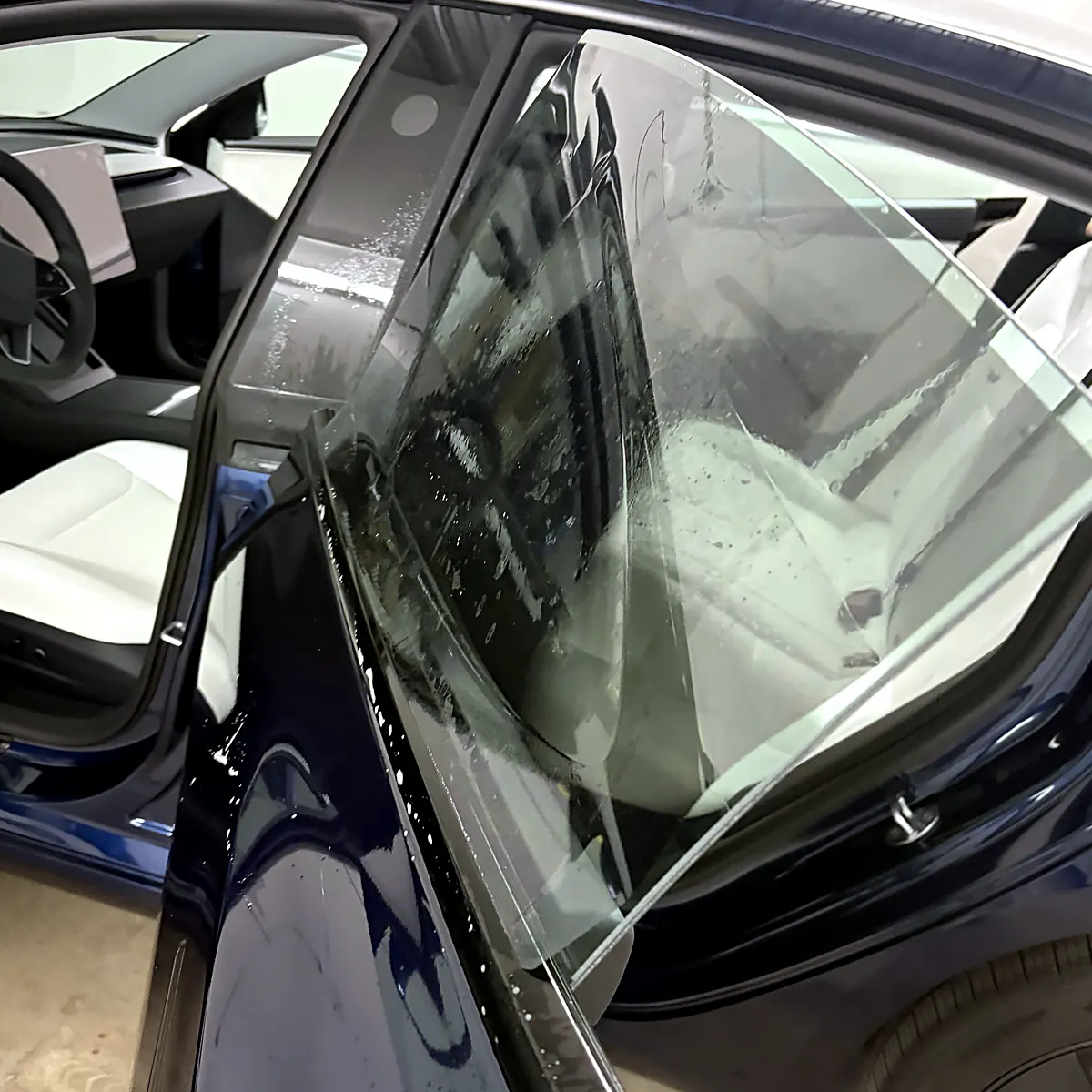
Regular tint is cheap because the film is cheap, and the film is cheap because dye does all the work until the sun wears it out. Ceramic film costs more up front. It rejects heat at any shade and leaves your phone and GPS alone. Whether the extra is worth it depends on where your car spends its days, and this article also says when it is not.
What “regular” tint is
When an Ottawa shop advertises an “all around” tint special at a price that seems too good, the film behind it is almost always dyed, and sometimes carbon. Those two are what most people mean by regular tint. Dyed film is the oldest and cheapest kind: a layer of dye laminated between a polyester sheet and its adhesive. It darkens the glass and takes some of the edge off glare, and whatever heat it stops, it stops by absorbing it. That is the whole story, and it is also the problem.
Dye is not stable under ultraviolet light. Every summer the dye breaks down a little further, and the colour drifts from charcoal toward the purple on rear windows all over the city. Because dyed film absorbs heat instead of turning it away, the film itself runs hot, and a year of Ottawa heat cycling works on the adhesive underneath. That is where the bubbles come from: the adhesive lets go in spots and air gets in. There is no repairing it; the film comes off and gets paid for twice.
Carbon film is the step up inside the regular tier. Carbon particles replace some or all of the dye, so the film holds its colour longer and rejects more heat without any metal in the layer. Plenty of shops carry it, and so did we. It left our shelf along with dyed film for the same reason: over the years both lose colour and heat rejection that ceramic holds on to, and we would rather not sell a film we expect to be replacing.
What ceramic tint is, and what nano ceramic adds
Ceramic film replaces the dye with ceramic particles spread through the film layer. Ceramic is not a metal and does not conduct, and those particles are what reject infrared, the part of sunlight you feel as heat but cannot see. Because the ceramic does the heat work, the colour of the film does not have to, and because there is no metal in it, GPS, phone signal and satellite radio work exactly as they did on bare glass. Both of the films we carry block 99% of UV, the part of the spectrum that fades seats and cracks dashboards through a closed window.
Nano ceramic is the same idea taken further. The ceramic particles are finer and more densely packed, so the film rejects more infrared for a given shade and holds sharper optical clarity, day and night. It rejects up to 85% of infrared heat, the most of anything we install, and it is what most Ottawa drivers pick for a vehicle that sits in the sun. That is the whole line-up, ceramic as the accessible option and nano ceramic as the stronger one. Everything below them we stopped selling. Both films are described in full on our window tinting page.
Does ceramic tint make a difference you can feel?
Park two identical cars in the Bayshore lot on a July afternoon, one with dyed film and one with nano ceramic, and come back after an hour. Both cabins are hot; a closed car in direct sun always is. The difference is the steering wheel you can hold and the seat you can sit on without flinching. The dyed film has spent the hour absorbing the sun’s energy and passing a good part of it inward. The ceramic has spent it turning infrared away before it reached the cabin, so the air conditioning has less ground to make up.
Glare is the second place you feel it. Westbound on the Queensway at sunset, the sun sits exactly where the visor cannot reach it. Dyed film cuts glare in proportion to how dark it is, and that is its only tool. Ceramic handles heat at a lighter shade, so you can run a lighter film on the front doors and still see the lane beside you at dusk. Low winter sun off fresh snow does the same thing in January.
January is also where the two films part ways for good. Every cold morning the rear defroster warms the glass from the inside while the outside sits well below freezing. Dyed film that ran hot all summer takes that cycling on an adhesive that is already tired, which is why the first bubbles on a cheap tint so often show up in spring. Ceramic has not been storing heat, and the winter does not bother it. Either way, the defroster clears the frost, and an ice scraper never touches the inside of tinted glass.
Is 35% or 20% tint darker, and does darker mean cooler?
Tint darkness is measured as visible light transmission, VLT: the share of visible light that makes it through the glass and the film together. A lower number lets less light through, so 20% is darker than 35%. Two things trip people up here. Factory glass is not perfectly clear to begin with, so the number printed on a roll of film and the number on the finished window are not the same thing, and the finished window is the one you live with. And the darkness number says nothing about heat.
Heat rejection comes from the film type, not from the shade. Infrared is not visible light, so a film built to reject it can do that at any darkness, and a film that was not built to reject it cannot make up the difference by going darker. Dyed film gets whatever heat performance it has by absorbing visible light, so darker is its only lever, and even dark dyed film runs hot. A light ceramic beats a dark dyed film on heat, and a light nano ceramic beats them both. The shade preview on our tint page shows the common shades side by side. Every film we carry comes with its measured visible light transmission figure, and you can look at both films before you choose.
Ceramic vs regular tint cost in Ottawa
The “all around” specials advertised around Ottawa are priced to get the car in the door, and what goes on the glass is usually dyed film with a short life ahead of it. We do not compete in that tier because we do not stock the film it is made of.
Our two films sit above it. Window tinting at Wrap Senators runs $300 to $800 depending on the size of the vehicle, the number of windows and which film you choose. Ceramic is the lower price of the two; the extra you pay for nano ceramic buys the higher infrared rejection. An SUV or truck with more glass sits toward the top of either film’s band. The split by film and vehicle size is in the packages section of our tint page, and the quote calculator will put a number on your own vehicle. Our Ottawa cost guide sets tint beside every other price we publish. Call before you budget from any of them; there is often a better price than the range shown.
How long each lasts, and what the warranty covers
Dyed film has a short life, and it tells you when it is over: the colour shifts first and the bubbles follow. By then the only fix is to strip it and start again. Carbon lasts longer but does not hold up the way ceramic does. A quality ceramic or nano ceramic film typically lasts 5 to 10 years, less if the vehicle lives a hard outdoor life, and it ages by getting old rather than by turning purple.
Two warranties stand behind our installs, and they cover different things. The film itself carries a lifetime warranty from its manufacturer. The installation is ours, and it is covered by our 5-year workmanship warranty. One answers for the material and the other for the work, and we tell you at booking which applies to what. Aftercare is the same for both films and it is not much: a gentle cleaner on a soft cloth, and never anything abrasive on the inside of the glass. Our window tinting guide walks through the first week.
Ceramic the film is not ceramic the coating
The word “ceramic” appears twice on our services menu, and the two get mixed up often enough to deserve a paragraph. Ceramic tint is a window film: a sheet with ceramic particles in it, applied to the inside of the glass to keep heat and UV out of the cabin. Ceramic coating is a liquid that goes on the paint and cures into a hard, slick layer that water and road film slide off. One lives on your windows and changes how the cabin feels. The other lives on your body panels and changes how the car washes. They share a word and nothing else, and neither one stands in for the other.
Which one we would put on your car
If the car spends its days outdoors, nano ceramic. A commuter that sits in a Kanata park-and-ride lot all day or a work truck parked on the street in Vanier takes the full afternoon sun, and the higher infrared rejection is what you feel at the end of it. Black interiors and leather push the answer the same way, and so does an EV, because heat the film keeps out is heat the climate system does not have to fight.
If the car lives in a garage and does most of its driving before the sun is high or after it is down, ceramic is plenty. You get the same 99% UV blocking; you give up a little of the clarity and the top of the infrared range, which you were not going to feel much anyway. Both films come in shades light enough that the front glass reads nearly untinted from the sidewalk.
What we will not put on your car is dyed or carbon film, even if the budget only reaches the regular tier. Wait and save rather than pay for a film you will pay again to strip. Most installs are done the same day at our studio on Stevenage Drive, and the Ottawa tint page has the neighbourhood detail. Come and look at both films before you decide. Ask about either one and you get its measured visible light transmission figure with the quote.